Know who's calling before you pick up
A busy call centre used to start every call with a manual lookup. Now the caller, their history and their upcoming appointments are on screen before the phone call is answered.
- Kind of business
- Australian Allied Health Business
- The bottleneck
- Every call began with a manual lookup before any help could start
- What changed
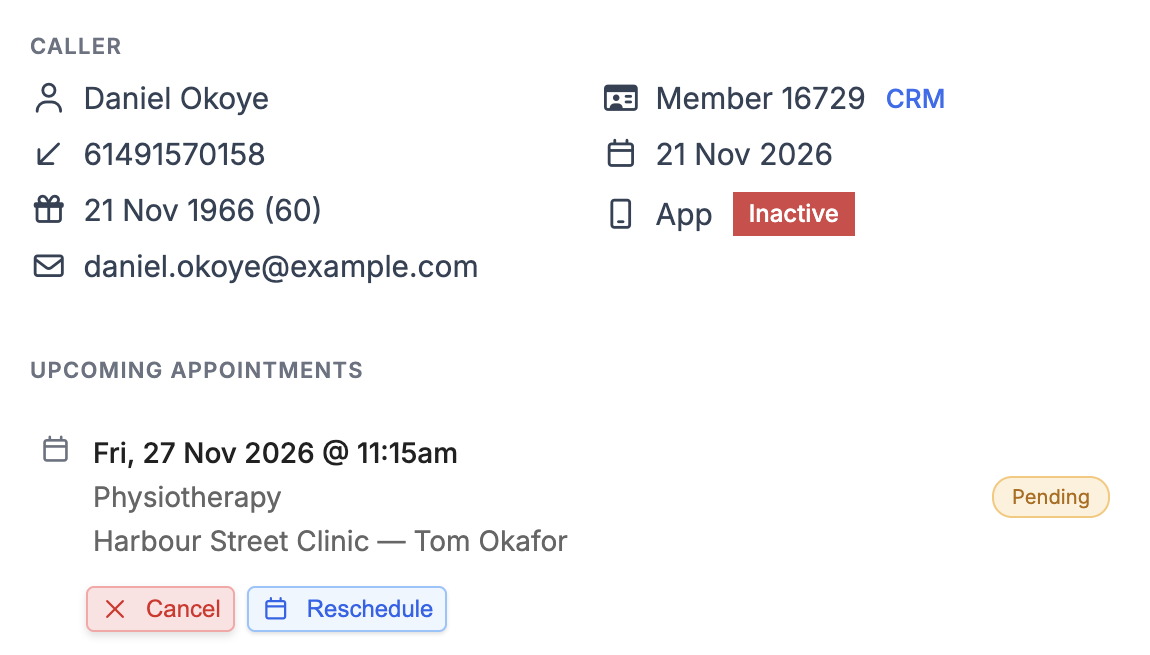
- The caller and their upcoming appointments are on screen before the call is answered, with cancel and reschedule actions one click away
The problem
Every call started the same way. The phone rang, someone answered, asked for a name, then searched for the customer while the caller waited. At more than a thousand calls on a typical weekday, that is a lot of waiting.
The request from the client was clear: when the phone rings, work out who's calling and open their record in the CRM.
It was a sensible ask. We started by asking why they needed the record open. What did the agent need to see? What did they need to do once they’d found it? We kept asking until we understood what the team needed on the call.
They wanted to know who was calling before they picked up, have a clue what the call might be about, and have the likely next step one click away.
When we started, by their count, more than half the calls were to cancel or reschedule an appointment. Could we have those actions ready while the phone was still ringing, with the buttons right there?
So that became the job.
What we did
The phone system worked. So did the CRM and the booking system. They just never talked to each other. So we built something in the middle.
- When the phone rings, a card appears on the board.
- While the phone’s ringing, we look up the caller by number. If it matches a customer, the card fills in with their name, history and upcoming appointments.
- The agent can cancel an appointment or start rescheduling it from the card. No need to open the CRM or hunt through the diary.
What changed
Here is a typical call now.
The phone rings, and in under a second there is a card on the board. About two seconds in, the card shows who is calling, their history and their upcoming appointments. Agents typically answer at around four to five seconds, so they pick up already knowing who it is and what the call might be about.
Feedback from the team: calls are shorter, fewer appointments end up cancelled, and new staff find their feet sooner.
Then it spread. We built it for the client service team. The sales team saw it, loved it, and asked for one of their own. We shipped a version shaped around their sales calls, quickly and with small changes. That one is a story for another day.
What this means for a business like yours
They had two good systems that did not talk to each other. We replaced neither. We built something that sits in the middle: it listens to the phone system, reads from the CRM and booking system, and acts in it when someone clicks a button. Their data stays where it has always lived.
You probably own both halves of this already: a phone system, and a system that knows your customers. The work is joining them.
Three habits did the rest. We built what was needed, not what was first asked; the useful answer was one question further on. We put small tools where the work happens, on the call itself. And we started with the most common case, released it, watched how it was used, then decided what came next.